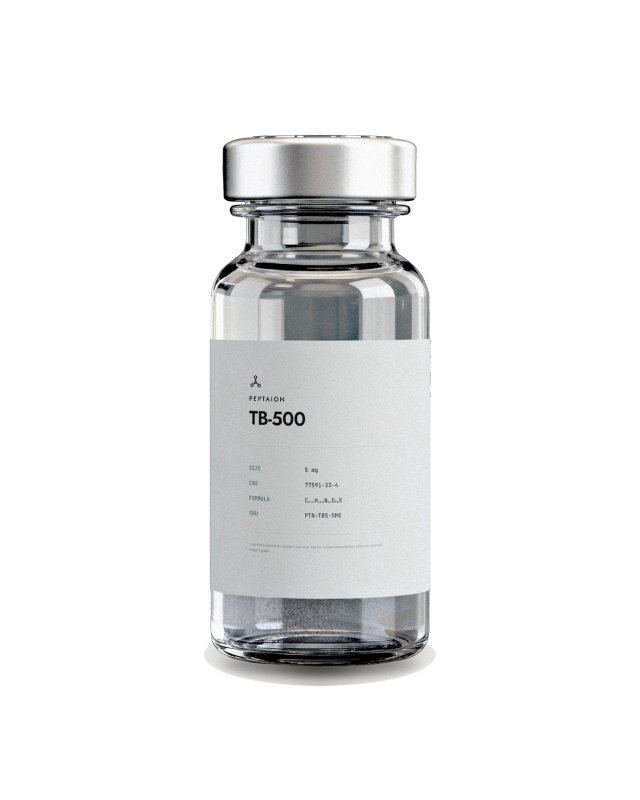
HPLC certificate of analysis pending — typically published within a month of batch receipt.
Research at a glance
TB-500 is a synthetic form of thymosin beta-4 (Tβ4), a highly conserved 43-amino-acid peptide encoded by the X-linked TMSB4x gene and characterised as the predominant β-thymosin in mammalian cells. Preclinical literature characterises it as an actin-sequestering, cytoprotective and tissue-repair-associated regulator, most studied in models of organ injury, fibrosis, and regeneration across cell, organoid, and rodent systems. The evidence base is predominantly in vitro and animal, together with narrative reviews; controlled human data remain limited.
In a study of autologous fat grafting combining adipose-derived stem cells and adipocytes, thymosin beta-4 was associated with increased formation of tunneling nanotubes and mitochondrial transfer via up-regulation of the Rac/F-actin pathway, reported alongside reduced oxidative stress and apoptosis and improved graft volume retention.[1]
In vitroAnimalPreliminaryIn a high-fat-diet rat model of non-alcoholic fatty liver disease and in palmitic-acid-treated LO2 hepatocytes, thymosin beta 4 was associated with modulation of ferroptosis-related gene expression, including up-regulation of GPX4, along with reduced inflammation and reactive oxygen species accumulation.[2]
In vitroAnimalPreliminaryA review has synthesised preclinical evidence on the thymosin beta 4–Ac-SDKP axis in kidney disease, describing cytoprotective, anti-inflammatory and antifibrotic actions across models of acute and chronic kidney injury while noting bidirectional, model-dependent effects and translational considerations such as peptide stability and delivery.[3]
ReviewEmergingIn human iPSC-derived cerebral organoids carrying familial Alzheimer disease APP mutations and in 5xfAD model mice, reduced TMSB4X expression was observed, and thymosin beta 4 treatment was associated with rescue of neurodevelopmental deficits and reduced β-amyloid formation, characterising it as a candidate neuroprotective factor.[4]
In vitroAnimalPreliminary
What the research does not show
The human evidence identified in this search is limited in scale; larger controlled trials establishing exposure and long-term safety in humans are not yet available.
Handling & storage
Lyophilized (sealed): store at −20 °C, protected from light.
Reconstituted: store at 2–8 °C; use within a few weeks.
Avoid repeated freeze–thaw cycles and prolonged light exposure.
Reconstitution reference — concentration calculator
Enter a volume of bacteriostatic water to see the resulting concentration of the reconstituted vial.
A concentration reference for lab handling — not a dose or administration instruction.
Studied alongside
Compounds investigated together in the research literature, and how they compare. Shared research focus is marked *; the rest is where they differ.
TB-500 and BPC-157 are frequently co-studied: both are examined in tissue repair, inflammation, muscle and tendon research, and they recur together across the cited reports. The pairing reflects a shared research context and overlapping study areas rather than a demonstrated combined interaction.
Compare the two compounds
References
References (8)
- 1.Zhang X et al., Free radical biology & medicine 2025Free radical biology & medicine, 2025· In vitro, Animal
- 2.Zhu Z et al., European journal of pharmacology 2021European journal of pharmacology, 2021· In vitro, Animal
- 3.Di H et al., Peptides 2026Peptides, 2026· Review
- 4.Zeng PM et al., Stem cell reports 2025Stem cell reports, 2025· In vitro, Animal
- 5.Mendias CL et al., Sports medicine (Auckland, N.Z.) 2026Sports medicine (Auckland, N.Z.), 2026· Review
- 6.Nguyen C et al., Current sports medicine reports 2026Current sports medicine reports, 2026· Review
- 7.Mazza AD. et al., Integrative medicine (Encinitas, Calif.) 2026Integrative medicine (Encinitas, Calif.), 2026· Review
- 1.Goldstein et al., thymosin beta-4 review · Annals of the New York Academy of Sciences, 2012
Sources last reviewed 19 Jul 2026