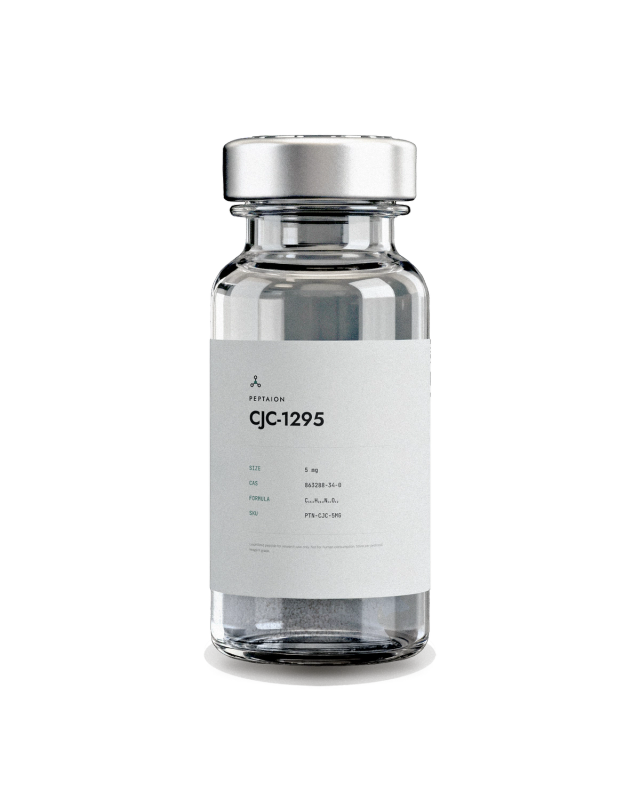
HPLC certificate of analysis pending — typically published within a month of batch receipt.
Research at a glance
CJC-1295 without DAC (also known as modified GRF 1-29) is a synthetic analogue of the first 29 amino acids of growth-hormone-releasing hormone (GHRH). It is the short-acting form: unlike the long-acting DAC (drug-affinity-complex) variant, which carries a maleimidopropionic acid group that covalently binds plasma albumin to prolong its half-life, the no-DAC peptide lacks that group. Most indexed CJC-1295 literature concerns the long-acting DAC variant, chiefly in analytical and anti-doping detection contexts; controlled research on the short-acting no-DAC form specifically is limited.
In an analytical study of the long-acting DAC variant of CJC-1295 in equine plasma, the peptide has been described as a 30-amino-acid form bearing a reactive maleimidopropionic acid group that covalently binds plasma proteins, and an immuno-PCR assay was reported to detect the conjugate at concentrations down to 0.8 pg/mL following administration in thoroughbred race horses.[1]
AnimalPreliminaryIn an analytical study of the long-acting DAC variant using equine plasma, CJC-1295 was characterised as conjugating to serum albumin via a C-terminal maleimido group to yield long-lived protein conjugates, and an LC-MS/MS confirmation method identified the peptide at concentrations as low as 180 pg/mL.[2]
AnimalPreliminaryIn the analysis of an unknown pharmaceutical preparation by LC-HRMS/MS, a 29-amino-acid peptide with a C-terminal amide consistent with the sequence marketed as CJC-1295 was identified and described as a growth-hormone-releasing factor available outside completed clinical trials.[3]
In vitroPreliminary
What the research does not show
No human clinical studies were identified in this literature search; reported findings derive from in vitro and animal models and have not been established in humans. Human pharmacokinetics, effective exposure, and long-term safety remain uncharacterised.
Handling & storage
Lyophilized (sealed): store at −20 °C, protected from light.
Reconstituted: store at 2–8 °C; use within a few weeks.
Avoid repeated freeze–thaw cycles and prolonged light exposure.
Reconstitution reference — concentration calculator
Enter a volume of bacteriostatic water to see the resulting concentration of the reconstituted vial.
A concentration reference for lab handling — not a dose or administration instruction.
Studied alongside
Compounds investigated together in the research literature, and how they compare. Shared research focus is marked *; the rest is where they differ.
CJC-1295 and Ipamorelin are frequently co-studied: both are examined in growth research, and they recur together across the cited reports. The pairing reflects a shared research context and overlapping study areas rather than a demonstrated combined interaction.
Compare the two compounds
References
References (6)
- 1.Timms M et al., Drug testing and analysis 2019Drug testing and analysis, 2019· Animal
- 2.Timms M et al., Drug testing and analysis 2019Drug testing and analysis, 2019· Animal
- 3.Henninge J et al., Drug testing and analysis 2010Drug testing and analysis, 2010· In vitro
- 4.Dominikowski A et al., Frontiers in endocrinology 2026Frontiers in endocrinology, 2026· Review
- 5.Mavrych V et al., Frontiers in aging 2026Frontiers in aging, 2026· Review
- 6.Mayfield CK et al., The American journal of sports medicine 2026The American journal of sports medicine, 2026· Review
Sources last reviewed 19 Jul 2026