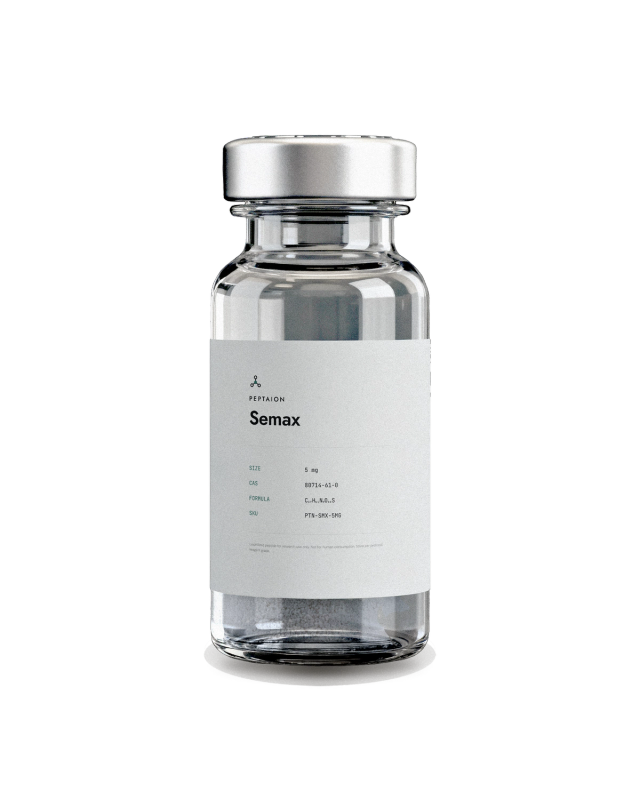
HPLC certificate of analysis pending — typically published within a month of batch receipt.
Research at a glance
Semax (Met-Glu-His-Phe-Pro-Gly-Pro) is a synthetic heptapeptide derived from a fragment of the adrenocorticotropic hormone (ACTH(4-7)) linked to a Pro-Gly-Pro sequence. The literature characterises it as a melanocortin-derived peptide studied chiefly in models of cerebral ischaemia and, more recently, in amyloid-aggregation and membrane systems, where its transcriptomic, proteomic, and molecular effects have been examined. The evidence base is predominantly preclinical (rat models and in vitro assays), with only limited controlled human data reported.
In a rat transient middle cerebral artery occlusion (tMCAO) model of cerebral ischaemia-reperfusion, Semax administration was associated with suppressed expression of inflammation-related genes and activated expression of neurotransmission-related genes at the transcriptome level, as characterised by RNA-Seq analysis.[1]
AnimalPreliminaryIn a rat tMCAO model of cerebral ischaemia-reperfusion, Semax was associated with upregulation of active CREB in subcortical structures and downregulation of MMP-9, c-Fos, and active JNK in adjacent tissues, as characterised by brain protein expression profiling.[2]
AnimalPreliminaryIn a study of patients following ischaemic stroke, administration of Semax alongside rehabilitation was associated with increased plasma BDNF levels and with changes in motor performance and Barthel index scores across early and late rehabilitation groups.[3]
HumanEmergingIn artificial membrane models and in vitro spectrofluorometric, calorimetric, and MTT assays, Semax was characterised as forming a complex with Cu2+ ions and as interfering with copper-induced amyloid-beta aggregation and fiber formation.[4]
In vitroPreliminary
What the research does not show
The human evidence identified in this search is limited in scale; larger controlled trials establishing exposure and long-term safety in humans are not yet available.
Handling & storage
Lyophilized (sealed): store at −20 °C, protected from light.
Reconstituted: store at 2–8 °C; use within a few weeks.
Avoid repeated freeze–thaw cycles and prolonged light exposure.
Reconstitution reference — concentration calculator
Enter a volume of bacteriostatic water to see the resulting concentration of the reconstituted vial.
A concentration reference for lab handling — not a dose or administration instruction.
References
References (8)
- 1.Filippenkov IB et al., Genes 2020Genes, 2020· Animal
- 2.Sudarkina OY et al., International journal of molecular sciences 2021International journal of molecular sciences, 2021· Animal
- 3.Gusev EI et al., Zhurnal nevrologii i psikhiatrii imeni S.S. Korsakova 2018Zhurnal nevrologii i psikhiatrii imeni S.S. Korsakova, 2018· Human
- 4.Sciacca MFM et al., ACS chemical neuroscience 2022ACS chemical neuroscience, 2022· In vitro
- 5.Rahman OF et al., Journal of the American Academy of Orthopaedic Surgeons. Global research & reviews 2026Journal of the American Academy of Orthopaedic Surgeons. Global research & reviews, 2026· Review
- 6.Panikratova YR et al., Doklady biological sciences : proceedings of the Academy of Sciences of the USSR, Biological sciences sections 2020Doklady biological sciences : proceedings of the Academy of Sciences of the USSR, Biological sciences sections, 2020
- 7.Slominsky PA et al., Doklady biological sciences : proceedings of the Academy of Sciences of the USSR, Biological sciences sections 2017Doklady biological sciences : proceedings of the Academy of Sciences of the USSR, Biological sciences sections, 2017
- 1.Kaplan et al., semax neuroprotection review · Neuroscience and Behavioral Physiology, 2002
Sources last reviewed 19 Jul 2026