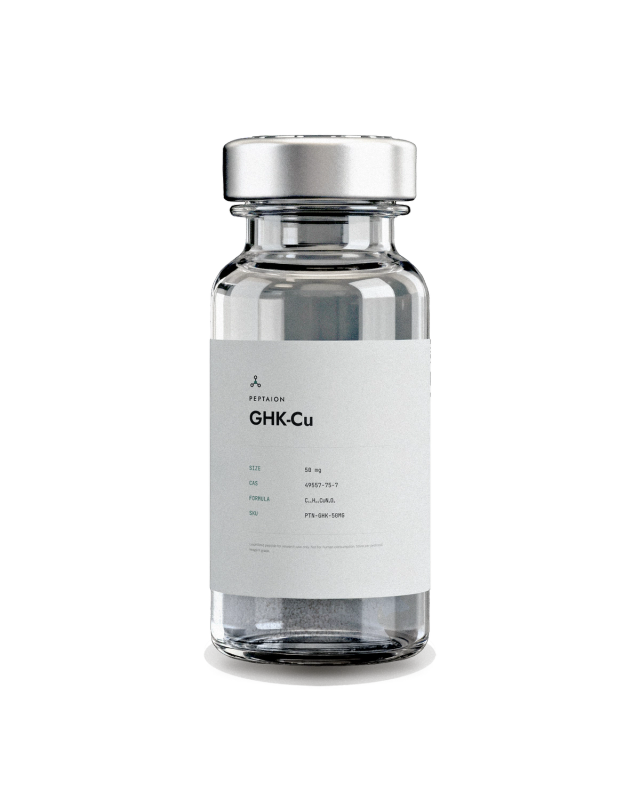
HPLC certificate of analysis pending — typically published within a month of batch receipt.
Research at a glance
GHK-Cu (glycyl-L-histidyl-L-lysine copper complex, also called copper tripeptide-1) is a copper-binding tripeptide derived from a sequence that occurs naturally in human plasma, urine, and other body fluids. The literature characterises it as a copper-carrying biomimetic peptide studied chiefly in the context of skin delivery, cosmetic formulation, and antioxidant/anti-inflammatory mechanisms, with attention to its limited permeation through the stratum corneum. The evidence base is predominantly in vitro, formulation-based, and invertebrate/animal model work, with controlled human data remaining limited.
In a review of cosmetically active compounds, GHK-Cu has been characterised as a hydrophilic tripeptide with limited permeation through the lipophilic stratum corneum, and liposomal encapsulation has been discussed as an approach studied for improving its skin transport.[1]
ReviewEmergingIn in vitro and in vivo LPS-induced inflammation models, a GHK-Cu-loaded hydroxyapatite microsphere gel filler was associated with reduced inflammatory factor and reactive oxygen species levels alongside increased superoxide dismutase, in a study focused on sustained peptide release.[2]
In vitroAnimalPreliminaryIn a formulation study, GHK-Cu has been studied as a cargo for anionic and cationic lecithin-based liposomes, with characterisation of encapsulation efficiency and in vitro tyrosinase and elastase inhibition assays.[3]
In vitroPreliminaryIn the model organism Caenorhabditis elegans, GHK-Cu administration was associated with extended lifespan and altered aging-related phenotypes, including enhanced oxidative and thermal stress resistance and changes in mitochondrial function linked to DAF-16/SKN-1 pathway activation.[4]
AnimalPreliminary
What the research does not show
The human evidence identified in this search is limited in scale; larger controlled trials establishing exposure and long-term safety in humans are not yet available.
Handling & storage
Lyophilized (sealed): store at −20 °C, protected from light.
Reconstituted: store at 2–8 °C; use within a few weeks.
Avoid repeated freeze–thaw cycles and prolonged light exposure.
Reconstitution reference — concentration calculator
Enter a volume of bacteriostatic water to see the resulting concentration of the reconstituted vial.
A concentration reference for lab handling — not a dose or administration instruction.
References
References (8)
- 1.Ogórek K et al., Molecules (Basel, Switzerland) 2025Molecules (Basel, Switzerland), 2025· Review
- 2.Hu D et al., Colloids and surfaces. B, Biointerfaces 2025Colloids and surfaces. B, Biointerfaces, 2025· In vitro, Animal
- 3.Dymek M et al., Pharmaceutics 2023Pharmaceutics, 2023· In vitro
- 4.Wen H et al., Biogerontology 2026Biogerontology, 2026· Animal
- 5.Hsiao CD et al., Biomolecules 2020Biomolecules, 2020
- 6.Zhang Q et al., Frontiers in molecular biosciences 2022Frontiers in molecular biosciences, 2022
- 7.Ha JW et al., Antioxidants (Basel, Switzerland) 2023Antioxidants (Basel, Switzerland), 2023
- 1.Pickart, GHK and copper-peptide research overview · BioMed Research International, 2015
Sources last reviewed 19 Jul 2026